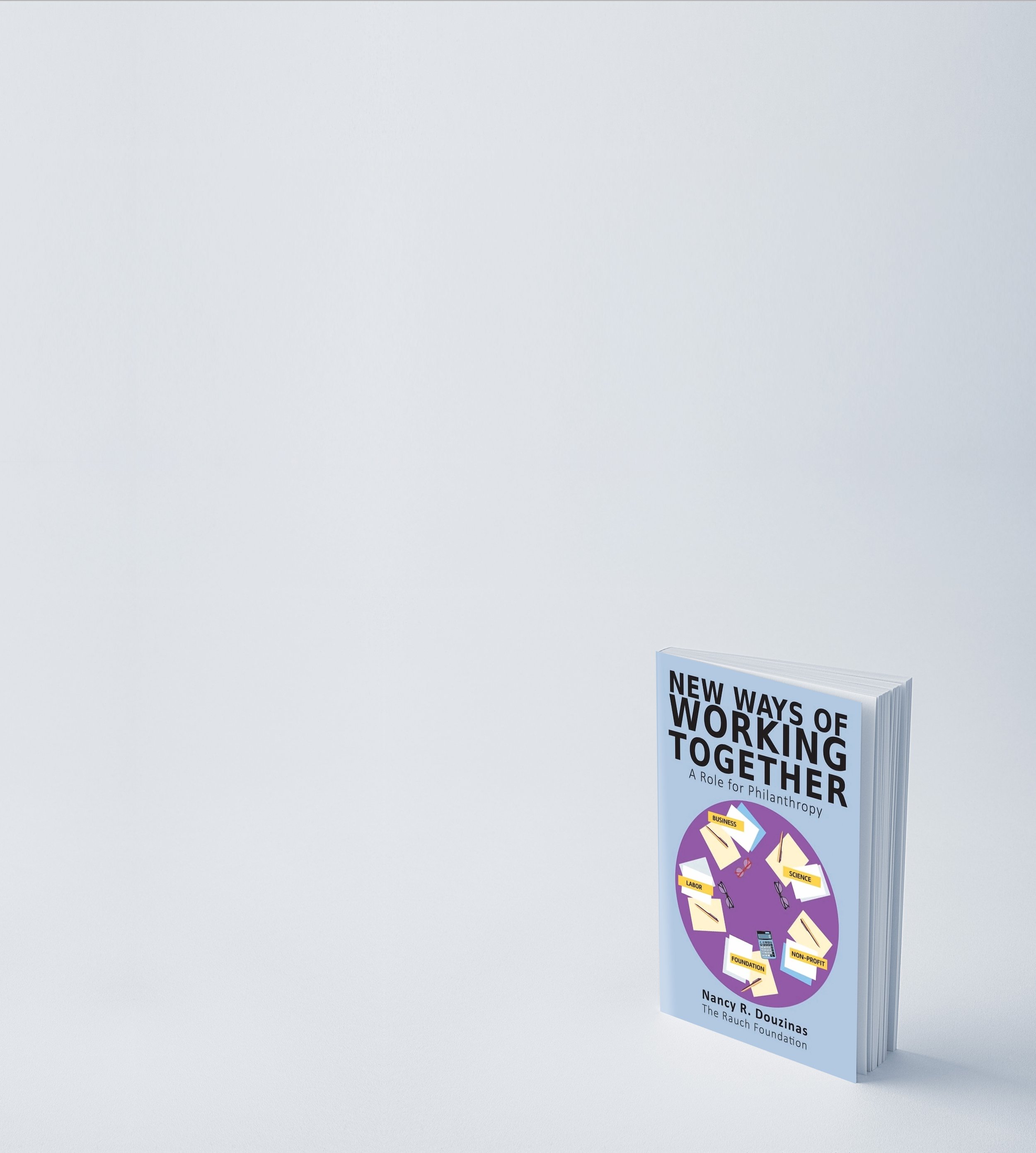
New Ways of Working Together: A Role for Philanthropy recounts how the Rauch Foundation, a privately administered family philanthropy established in the 1960s, drastically redefined its role with the goal of achieving far greater regional impact on Long Island. Through compelling visual storytelling—including cartoons, infographics, and video—alongside rigorous research and hard facts, the Foundation found new ways to communicate complex ideas, connect people around shared challenges, and advance regional change.
About the Book
We are in the early days of a potentially cataclysmic shift away from government financial support for non-profits. This financial collapse crosses the spectrum of programmatic areas: science, medicine, education, transportation, agriculture, the environment, arts and culture and more. Philanthropy as traditionally practiced at the institutional, family foundation, or individual level cannot close the funding gap. We are also on the cusp of the largest transfer of wealth in US history. Those in a position to give need new ways to operate in a dramatically different ecosystem.
New Ways of Working Together: A Role for Philanthropy recounts how the Rauch Foundation, a privately administered family philanthropy established in the 1960s, drastically redefined its role with the goal of achieving far greater regional impact on Long Island. Their evolution meant forming organic, tri-sector alliances, where stakeholders can come together to nimbly solve community problems without the weight of formal structures. While the story centers on the challenges Long Island faced, it offers insights applicable to any region in need and specific steps philanthropic leaders can adopt.
The book profiles numerous individuals whose expertise and commitment contributed to the Rauch Foundation's breakthrough successes. These profiles suggest the diversity and availability of the sort of “outsiders” foundations should be actively recruiting to enhance their capacity for affecting meaningful change.
This book advocates for
expanding philanthropy’s role beyond giving to convening
exercising the power of solid data to move policy
learning how to seek outside guidance and identify powerful partners
forming mutually beneficial partnerships with public and private entities
re-orienting the board to lead with greater intention
overcoming risk aversion by managing potential downsides
discovering talent wherever it exists
-
The Rauch Foundation was intimately involved in creating partnerships that have helped to strengthen Long Island’s civic and social fabric over the years. Two notable examples described in this book are (1) Energeia, a two-year leadership program for young and mid-career professionals from all sectors, and (2) Accelerate Long Island, a select consortium consisting of top regional scientific institutions as well as legal, accounting, and investment firms. Both organizations are committed to developing strategic alliances and supporting innovation through high tech business development. Similarly, the Long Island Index, the Rauch Foundation’s single largest investment, grew organically from the groundwork established through such seeding of cross-sector relationships. The foundation managed the index as an operating grant for more than fifteen years. At its inception, two taglines were adopted: “Working together in new ways,” and “Good information presented in a neutral manner can move policy.” These taglines reveal the index’s approach in a concise manner. This book examines how the foundation used convening, research, relationship-brokering, many forms of communication,and real-world examples gathered from learning trips to other regions to bring about real change on a regional scale.
About the Rauch Foundation
From 1992 to 2022 the Rauch Foundation was engaged in many forms of entrepreneurial social change making on Long Island and in Maryland. While much innovative and effective, environmentally focused grant-making took place in Maryland, this book focuses on the philanthropic initiatives on Long Island. Using a systems model of change, the foundation was able to create meaningful, measurable impact in a highly fractured region where making change is extremely difficult. While the events are specific to Long Island, many of the lessons learned have value for foundations working in other regions.